A study published in Nature Geoscience proposes that Earth manufactured much of its water during its formation rather than receiving it from comets or asteroids. The lead authors are Susmita Garai, a graduate student in Earth and Planetary Sciences at the University of New Mexico, and Zachary Sharp, a professor and director of the department. Universe Today reported the findings on Thursday.
The paper is titled "Dry pebble rain could have delivered water to Earth through hydrogen reduction of iron oxide." Its central claim is that water can form inside the hot, hydrogen-rich envelope surrounding a young planet as it accumulates small silicate bodies.
Why it matters
Water is central to a planet's habitability, and where Earth's supply came from has been debated for decades. According to Universe Today, the delivery scenario faces timing problems: any explanation involving comets and asteroids must fit around the giant impact that formed the Moon, the Late Heavy Bombardment, and the mix of elements observed in Earth's mantle. The authors write that the sources of water for rocky planets, and when that water arrived, remain contested.
If the planet produced the water itself, those scheduling conflicts largely disappear. Sharp said in a press release that earlier ideas depended on an outside supplier such as comets or meteorites, whereas the new mechanism should give essentially any planet of Earth's size water, Universe Today reports.
How molten pebble rain could build an ocean
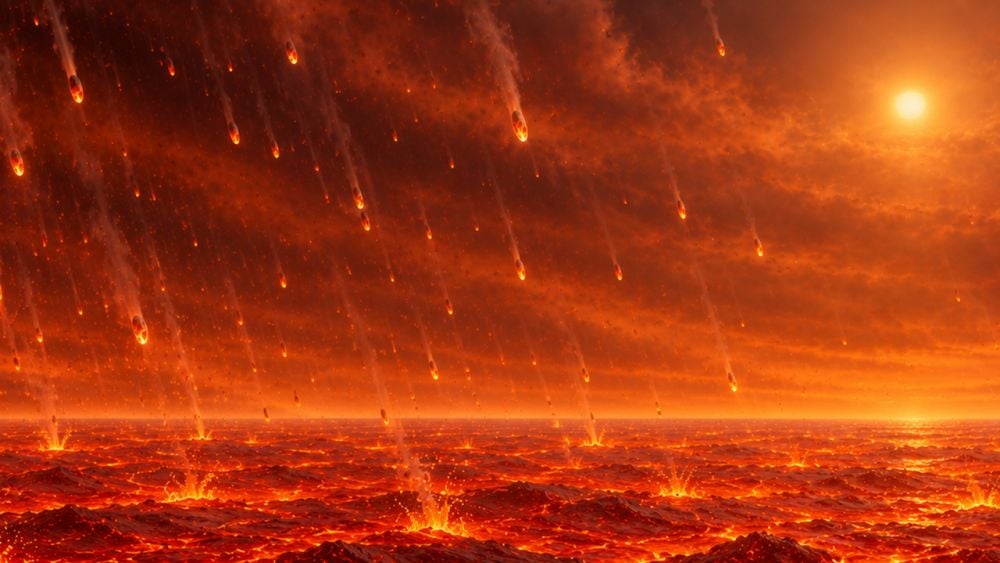
The researchers describe a young Earth in its magma ocean phase: a molten sphere wrapped in an atmosphere utterly unlike today's. Through that atmosphere fell a steady rain of chondrules and pebbles, millimetre- to centimetre-sized material that had condensed from the solar nebula and was drawn in by the planet's mounting mass.
Once a growing planet passes roughly 0.3 Earth masses, those pebbles descend slowly enough to spend hours or days above their melting point. In that state they undergo extensive reduction of iron oxide. Oxygen is stripped from the iron and released into the atmosphere, where it combines with hydrogen to form water, leaving metallic iron behind. The process requires a strong reducing agent at high temperature, and the heated hydrogen in the atmosphere fills that role.
The authors explain that the gravitational energy released as pebbles settle heats the atmosphere directly, producing a steep thermal gradient and, on large planets, extreme surface temperatures. These can surpass 3,000 kelvin, with pressures above 200 bars. A magma ocean warms the system from below as well. The combined effect, the researchers write, is molten pebble rain onto the surface, loss of volatiles from the pebbles in the atmosphere, and absorption of hydrogen, helium and other volatiles into the magma ocean.
Sharp described the setting in stark terms. "Looking out over a large body of water, it is hard to imagine that that water may have been produced 4 ½ billion years ago in a hell-like atmosphere, but it very well may have," he said, according to Universe Today.
High-temperature tests in the lab
To measure how much iron reduction occurs and how quickly, the team melted mafic and ultramafic silicate rocks — two iron- and magnesium-rich categories of igneous rock — in streams of hydrogen gas and, separately, in streams of helium. Samples were heated to between 1,200 and 1,400 degrees Celsius, with runs lasting from 15 minutes to three hours. The conditions approximated the period when Earth was large enough both to pull in pebble rain and to hold a hydrogen-dominated envelope.
Sharp credited the experimental work to his co-author. "In order to evaluate the possibility of 'pebble' rain' being a source of water, we needed to construct and execute some very challenging high temperature experiments," he said. "Dr. Garai's efforts paid off mightily, as she found that water is produced in just minutes in the high temperature environment of the Early Earth's atmosphere."
The authors conclude that oceans of water can be generated within the hot, hydrogen-rich atmosphere above a rocky planet that is growing by capturing silicate pebbles, as Universe Today summarises the paper.
The result does not rule out any contribution from impacting bodies. It does offer a route to Earth's water that does not depend on an external delivery schedule. Watch for follow-up work testing whether the same chemistry holds for planets of different sizes and for worlds outside the solar system.